Insights from Tyler Okland, MD
Deep Plane Facelift vs. SMAS Facelift vs. Mini Facelift
The names matter less than the anatomy beneath them. The practical distinction is how much structural release the operation creates, what tissue carries the correction, and whether the cheek, jawline and neck are treated as one connected system.
01Mini facelift~6 months–3 years
- Plane / release
- Primarily skin undermining with little structural release
- Typical correction
- Modest short-term tightening near the jawline
- Principal limitation
- Relies heavily on skin tension; limited cheek and neck correction
- Clinical expectation*
- ~6 months–3 years
1. Mini Facelift
In general, a mini facelift is a skin-dominant operation. The skin is undermined over a limited distance and pulled toward the ear; the deeper tissues are minimally mobilized. This can create temporary improvement in a carefully selected patient, but it cannot reproduce the correction of a comprehensive structural operation.
02Traditional SMAS lift~4–6 years
- Plane / release
- SMAS plication, imbrication or shorter SMAS flap
- Typical correction
- Better structural support than skin alone
- Principal limitation
- Anterior cheek/jowl remain limited when major retaining ligaments remain intact
- Clinical expectation*
- ~4–6 years
2. Traditional SMAS Lift
A traditional SMAS lift recognizes that skin alone should not hold the result. The surgeon tightens, folds or advances the SMAS, but often through a comparatively limited field. It is a meaningful step beyond skin-only surgery, yet the tissue farther forward remains constrained when the major ligament systems have not been released.
03Deep plane faceliftVaries with actual operation
- Plane / release
- Sub-SMAS dissection in the mobile face; extent varies
- Typical correction
- Composite cheek and jowl mobility beyond SMAS tightening
- Principal limitation
- The label alone does not define release, extension or neck work
- Clinical expectation*
- Varies with actual operation
3. Deep Plane Facelift
A deep plane facelift enters beneath the SMAS in the mobile portion of the face and extends the dissection toward the cheek and jowl. This allows skin, fat and SMAS to move as a composite unit with less reliance on skin tension. “Deep plane,” however, is a starting description—not proof that the operation is extended, ligament-releasing or comprehensive through the neck.
04Extended deep plane face + neck lift~10–15+ years; revision timing varies
- Plane / release
- Continuous sub-SMAS/subplatysmal field with comprehensive ligament release and individualized deep-neck work
- Typical correction
- Cheek, jawline and neck treated as one connected system
- Principal limitation
- Technically demanding; dependent on anatomy, vectors and judgment
- Clinical expectation*
- ~10–15+ years; revision timing varies
4. Extended Deep Plane Face and Neck Lift
The extended deep plane operation lengthens the sub-SMAS dissection and releases four key ligament systems: the zygomatic cutaneous, masseteric cutaneous, mandibular cutaneous and cervical retaining ligaments. That release creates a continuous field through the cheek, jawline and neck so the tissues can be repositioned rather than merely tightened at the edge.
*These lifespan ranges are general clinical expectations, not expiration dates or guarantees. Technique, anatomy, age, skin quality, weight change, surgeon quality, nicotine exposure and continued aging all influence durability. The dedicated longevity section below discusses the available long-term deep-plane evidence.
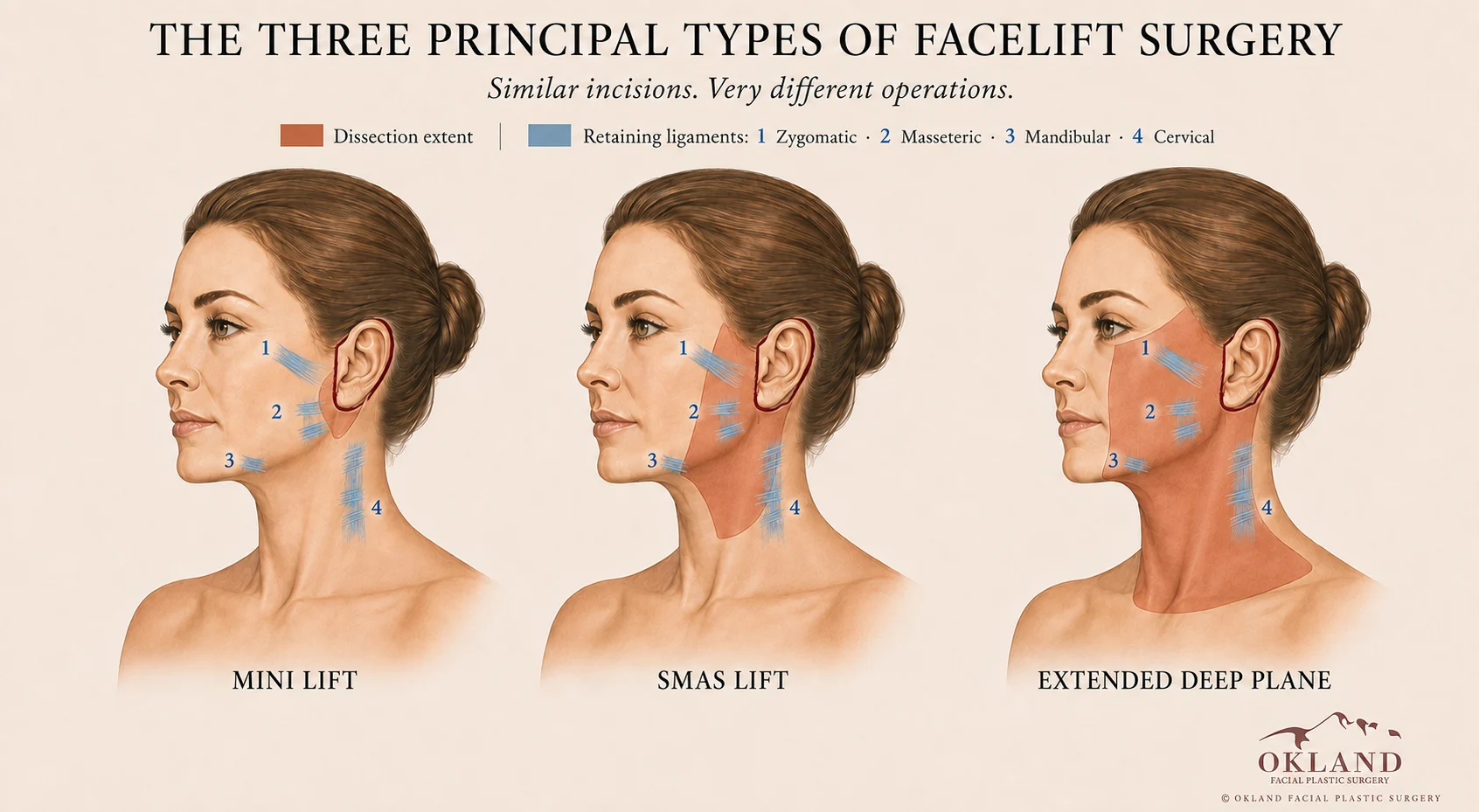
Illustrated comparison of facelift families.