Deep Neck Lift & Contouring by Tyler Okland, MD
Neck Lift in Denver, Colorado: Deep Neck Lift & Contouring
Deep neck surgery can powerfully reshape the neck. But when loose skin, jowls, or age-related facial descent are part of the problem, an isolated neck lift is incomplete by definition. A facelift includes the deep neck lift and adds the vertical vector the neck lift cannot create.
The Best Neck Lift Is Always a Facelift
Written and medically reviewed by Tyler Okland, MD. Last medically reviewed August 2026.

01The Diagnosis
Most patients who ask me for a neck lift are correctly identifying the area they dislike—and incorrectly identifying the operation they need.
The neck is where facial aging collects. It is not where aging begins.
Jowls are facial tissue that has crossed the jawline. Loose skin beneath the chin is often facial skin that has descended under the constant vertical pull of gravity. Gravity makes tissues fall in a vertical direction.
A deep neck lift is a powerful operation. It can contour the structures beneath the chin, tighten and reposition the platysma, redrape the neck skin, and remove excess skin. But an isolated neck lift works primarily through a horizontal vector. It does not vertically restore the descended face above the jawline.
A facelift does not replace the deep neck lift. It includes it. The difference is that the facelift adds the vertical facial lift that returns descended cheek, jowl, and facial skin upward after the neck is tightened horizontally.
That is why a neck lift alone is never superior to a properly performed facelift (which should always include a neck lift) for neck definition. The facelift contains the entire neck operation—and adds the vector the neck lift is missing.
A deep neck lift may still be a good procedure for you. The important thing is knowing whether your problem is isolated to the neck or whether the neck is showing the downstream effect of facial descent.
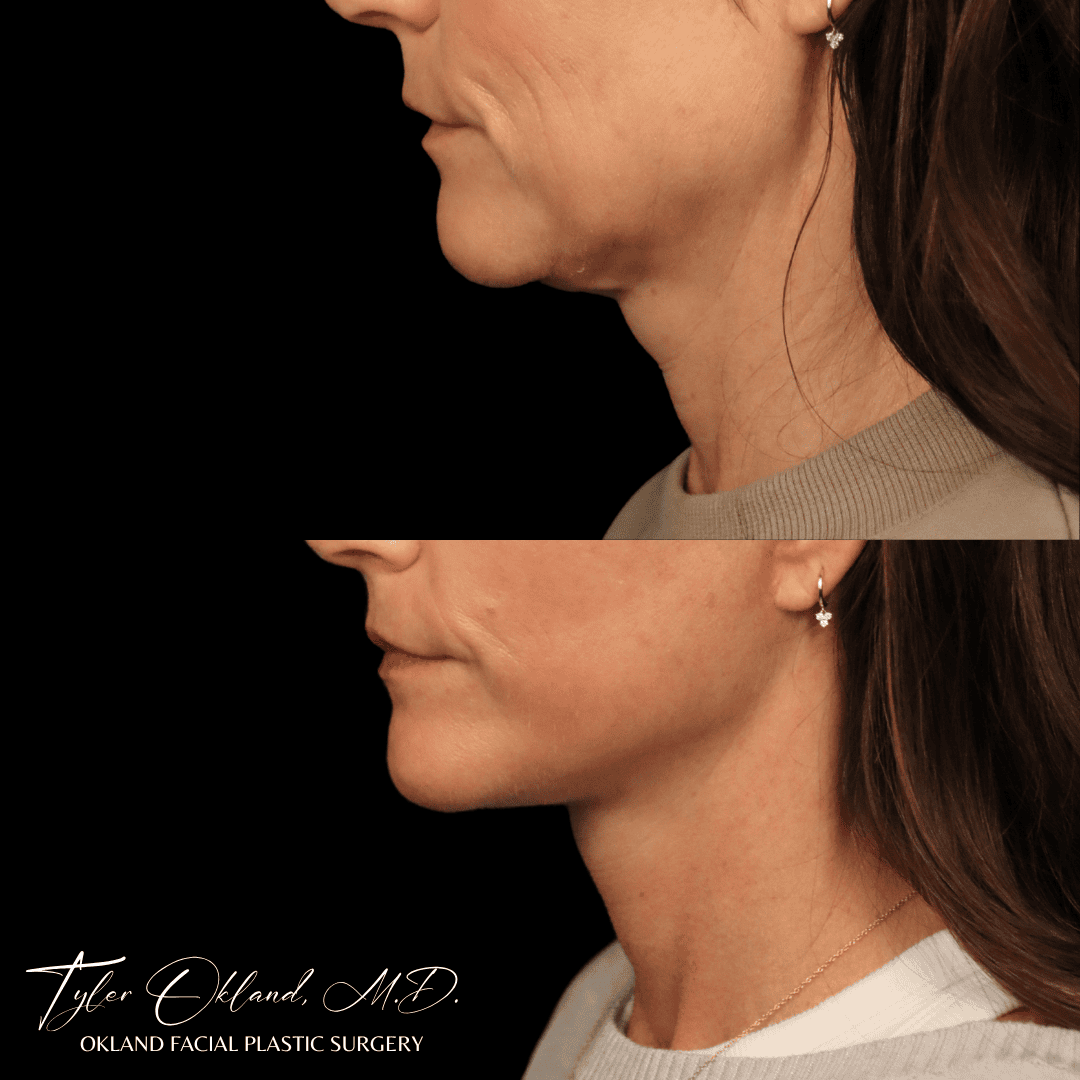
You Are Not Wrong About Your Neck. The Question Is Where the Problem Starts.
You might point beneath the chin and say, “This is the only area that bothers me.” But the location of the symptom does not determine the location of the cause. And if the underlying cause is left untreated, the chance of a neck lift giving you the result you are looking for is low.
For many patients, the diagnosis is not simply extra skin beneath the chin. The diagnosis is vertical facial descent masquerading as neck tissue.
02 · Deep Anatomy
What Is a Deep Neck Lift?
A true deep neck operation treats more than superficial fat. It evaluates the anatomy beneath the platysma—the broad sheet muscle that covers the front and sides of the neck—and addresses the specific structures creating fullness, banding, or loss of the cervicomental angle.
Depending on the patient, that may include superficial fat, subplatysmal fat, the platysma itself, prominent anterior digastric muscles, prominent submandibular glands, excess skin, and the skeletal relationship between the chin and neck.
The exact operation matters more than the label. “Deep neck contouring,” “deep neck lift,” “platysmaplasty,” and “deep plane neck lift” are often used online as though they were interchangeable. They are not.
What Does “Deep Plane Neck Lift” Mean?
“Deep plane neck lift” is a term patients increasingly encounter online. I care less about the phrase than what the surgeon is actually doing.
Ask what structures are actually treated, whether skin is excised, whether the platysma is lifted laterally, and whether the face above the jawline is released and moved vertically. In my practice, when facial descent is present, the deep neck lift is part of an extended deep plane facelift: the neck is treated deeply from below; the descended face is restored from above.
Platysma
Deep fat
Digastrics
Submandibular glands
Chin framework
03Direction Matters
Gravity Is Vertical. A Neck Lift Is Horizontal.
Gravity does not age the face and neck sideways. It pulls them down.
An isolated deep neck lift works primarily through horizontal correction. Through the submental incision I can contour the deep neck and repair the central platysma. Through incisions around the ears I can lift the platysma laterally, redrape the neck skin, and remove the excess. That can create a dramatic improvement.
But the operation remains a neck operation. It cannot vertically release and lift the cheek, lower face, jowl, and descended facial skin because those tissues are not being repositioned.
A facelift performs the same deep neck work and adds the vertical facial vector. That combination is the strongest operation for the neck because it corrects the neck from below and the descended face from above.
The Pants Test: Tightening Sideways Is Not the Same as Lifting Up
Imagine a pair of pants that has slipped downward and bunched at the knees. You can pull the fabric sideways at the knee, tighten it, and even cut away the excess. The knee will look smoother. But the pants are still sitting too low.
Now pull the waistband back to its correct height. The entire pant leg redistributes upward. The bunching at the knee improves because the material has been returned toward where it started.
A deep neck lift is the horizontal correction at the knee: powerful local tightening, platysma repositioning, and skin excision. A facelift restores the waistband. It lifts the descended facial envelope vertically and then uses the deep neck lift to define the neck horizontally.
The best neck uses both vectors when both problems are present.

04Compare the Operations
Neck Contouring vs. Deep Neck Lift vs. Facelift With Deep Neck Lift
These are different operations designed for different anatomy. They should not be collapsed into one generic “neck lift” category.
| Operation | What it treats | Vector / skin | Best candidate |
|---|---|---|---|
| Deep neck contouring | Superficial + deep fat, central platysmaplasty, digastrics, submandibular glands, chin-neck architecture. | No facial lifting vector or skin excision. Relies on strong skin elasticity to contract. | Usually younger patient with genetic neck fullness, stable weight, no jowls or loose skin. |
| Isolated deep neck lift | Everything in contouring plus lateral platysma lifting, neck-skin redraping, and excess skin excision. | Powerful horizontal neck correction. No vertical facial lift. | True isolated neck aging with preserved facial position and enough skin excess to require excision. |
| Extended deep plane facelift + deep neck lift | Deep neck structures, platysma, excess skin, jowls, lower face, midface, and vertically descended facial tissues. | Vertical facial restoration + horizontal neck definition. | Any patient whose neck laxity is caused or compounded by facial descent. |
What My Two Neck Procedures Actually Include
I perform two isolated neck operations: neck contouring and deep neck lift.
The two operations share the same central deep-neck work. A deep neck lift then goes considerably farther, extending the operation laterally beneath the jawline and into the lower face so that I can release, mobilize and suspend the platysma and lower SMAS from the chin all the way back to the angle of the mandible.
Deep Neck Contouring+
My deep neck contouring operation is performed through a small incision hidden beneath the chin.
I begin by contouring the supraplatysmal fat immediately beneath the jawline. I concentrate this work centrally and generally extend it laterally to approximately the midpoint of the mandible. This removes superficial fullness and begins defining the border between the jaw and neck.
I then separate the platysma muscles in the midline and enter the deeper neck beneath them. From this direct exposure, I can see and treat the structures that liposuction cannot reach.
The deep portion of the operation includes:
Sculpting excess deep neck fat beneath the platysma
Conservatively contouring the submandibular glands only when their prominence is physically preventing a clean jawline
Performing a small hyoid fasciotomy to improve the central neck contour
I then complete the central platysmaplasty and close the submental incision.
This is why I consider deep neck contouring an architectural operation. Rather than simply suctioning fat from underneath the skin, I am directly reshaping the different layers that determine the angle between the chin, jawline and neck.
What I am not doing is lifting the lateral neck or removing skin around the ears. The operation therefore depends on the patient's skin having enough elasticity to contract over the newly sculpted framework.
Deep Neck Lift+
My deep neck lift begins with the entire deep neck contouring operation described above.
I contour the supraplatysmal fat, enter beneath the platysma, sculpt the deep neck fat, address the submandibular glands when they interfere with the jawline, perform the hyoid fasciotomy and complete the central platysmaplasty.
Then I continue laterally.
I perform a low, inferior platysma myotomy, releasing the bottom of the platysma so that the muscle is no longer tethered inferiorly and can be mobilized more effectively.
I then make limited incisions behind the ears, around the earlobes and just in front of the tragus. I elevate a relatively small amount of skin surrounding the ear and enter the deep plane through the lower face and neck using my sailboat modification, while leaving the Roskies patch intact.
Once I am in the deep plane, I release the fixed attachments preventing the lower face and neck from moving freely. This includes the:
Masseteric retaining ligaments
Mandibular retaining ligaments
Cervical retaining ligaments
Fixed attachments of the lower SMAS and platysma
This release is important. Pulling on tissue that is still tethered does not create the same movement as first releasing the structures holding it down. The lift must be tension-free.
Once the lower SMAS and platysma are mobile, I create a mastoid crevasse behind the ear and suspend the platysma beneath the angle of the mandible. This allows me to pull the platysma firmly backward beneath the jawline and create definition extending continuously from the central neck all the way to the mandibular angle.
Any mobilized SMAS above the mandibular angle is then secured to Loré's fascia near the tragus.
The objective is not simply a tighter central neck. It is a clean, continuous jaw-neck transition from front to back.
The Surgical Difference+
Deep neck contouring reshapes the central architecture beneath the chin and jawline through a submental incision. It includes the deep structural work and central platysmaplasty, but it does not lift the lateral neck or remove skin. The result depends on the skin contracting over the new framework. This is generally a 1–1.5-hour surgery.
Deep neck lift includes all the above, then adds inferior platysma release, limited incisions around the ears, deep-plane lower-face and neck release, retaining-ligament release, and powerful lateral suspension of the platysma beneath the mandibular angle. This is generally a 3-hour surgery.
And then there is the facelift.
A deep neck lift can mobilize and suspend the lower face and neck horizontally. An extended deep plane facelift with a deep neck lift includes this neck operation and continues the release and elevation vertically through the face. It adds one additional hour of surgery.
That additional vertical vector is why, in a patient whose neck laxity is being driven by facial descent, the facelift remains the more complete operation.
05 · The Missing Vector
A Facelift Includes the Neck Lift—and Adds the Missing Vector
In my practice, a facelift is never performed without a deep neck lift. The neck is not an optional add-on. It is integral to the operation. A true deep plane facelift produces far too robust a lift to not include the neck lift automatically. If your surgeon discusses adding on a neck lift to your facelift, this is a red flag and should be explored.
Once I am already performing the deep neck work, adding the extended deep plane facial component adds roughly one hour and a modest extension of the incision. In return, it supplies the entire vertical facial lifting vector.
That allows me to release descended deep facial tissues, elevate the cheek and lower face, return the jowl above the mandibular border, and redistribute the skin envelope vertically. I then use the horizontal neck vector to define the jawline and neck from below.
For a patient with facial descent, choosing a neck lift alone means intentionally leaving the vertical problem untreated in exchange for a somewhat shorter operation and slightly less scar. That is not a worthwhile trade when the goal is the strongest possible neck result.
Explore the Extended Deep Plane Facelift06Which Operation Fits?
Who Actually Benefits From an Isolated Deep Neck Procedure?
The isolated deep-neck candidate exists. It is simply a narrow group.
- Usually younger than about 40.
- Neck heaviness has been present since adolescence or early adulthood.
- The problem is genetic rather than primarily weight-related.
- Weight is stable and reasonably close to the patient’s normal baseline.
- Skin elasticity is excellent.
- There is little or no jowling.
- The cheek and lower face have not meaningfully descended.
- There is little or no crepey or redundant skin beneath the chin.
- The goal is structural neck definition rather than facial rejuvenation.
For this patient, deep neck contouring or an isolated deep neck lift can be the correct operation. The distinction is whether the skin is capable of contracting on its own or whether it must be redraped and excised.
Who Needs a Facelift for the Best Neck?
If any meaningful part of the problem is vertical descent, the answer is a facelift with a deep neck lift.
- Loose skin beneath the chin.
- Jowls interrupting the mandibular border.
- A jawline that becomes markedly cleaner when the cheek is lifted upward with the fingers.
- Marionette-line heaviness or lower-face descent.
- Visible aging of both the face and neck.
- Skin that can be shifted upward rather than simply compressed.
- A desire for the strongest and cleanest neck definition the anatomy can support — this is most of you.
- Someone who would be dissatisfied if they still had a small amount of fullness or skin laxity under the chin after surgery.
A patient can be bothered only by the neck and still need a facelift. The symptom can be local even when the anatomy causing it is not.
07Definitions & Framework
Platysmaplasty Is Part of a Neck Lift—Not the Whole Operation+
Platysmaplasty means repairing or repositioning the platysma muscle. It can improve central neck bands and help create a cleaner muscular sling beneath the jawline.
But platysmaplasty does not tell you whether deep fat was removed, whether digastric or gland prominence was treated, whether the neck skin was excised, or whether descended facial tissue was lifted vertically. It describes one component of a neck operation, not the complete diagnosis or plan.
If your neck problem is caused by more than the platysma, a platysmaplasty alone is not a complete neck operation.
What Is a “Mini Neck Lift”?+
“Mini neck lift” is not a standardized anatomical operation. It usually means some version of limited dissection, limited skin redraping, or shorter incisions.
In my experience, smaller means less thorough. Mini procedures produce mini results.
If the problem is superficial and limited and your expectations are minimal, a smaller operation may be enough. If the problem is deep structural fullness, true skin excess, platysmal laxity, or vertical facial descent, reducing the operation does not change the anatomy that needs to be treated.
I do not view “mini” as a quality marker, and I do no mini procedures in my practice because I believe it would hurt my reputation. The question is whether the operation reaches the structures causing the problem.
The Neckline Begins With the Chin and Jaw+
A beautiful neckline is not created by removing tissue alone. The soft-tissue envelope needs an adequate skeletal framework.
A short or retrusive chin compresses the distance between the chin and neck, blunts the cervicomental angle, and can make normal soft tissue look heavy. Improving chin projection lengthens that relationship and gives the jawline and submental tissues a stronger scaffold. The less projected your chin, the more susceptible you will be to laxity.
Depending on the anatomy, that can be addressed with chin augmentation, structural fat transfer, or—more selectively—filler. None of these replaces a facelift when the tissues have descended. The scaffold and the tissue position are separate problems.
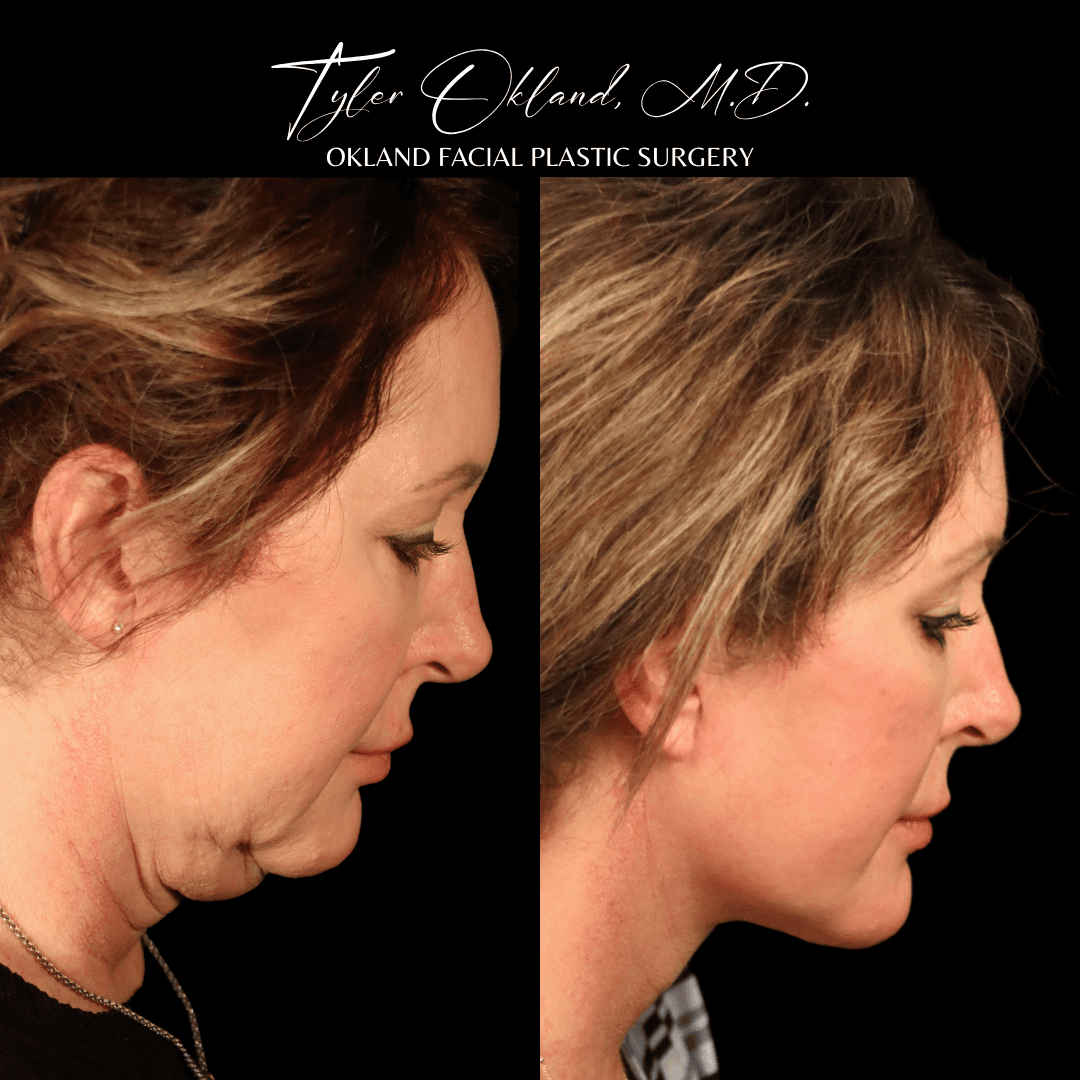
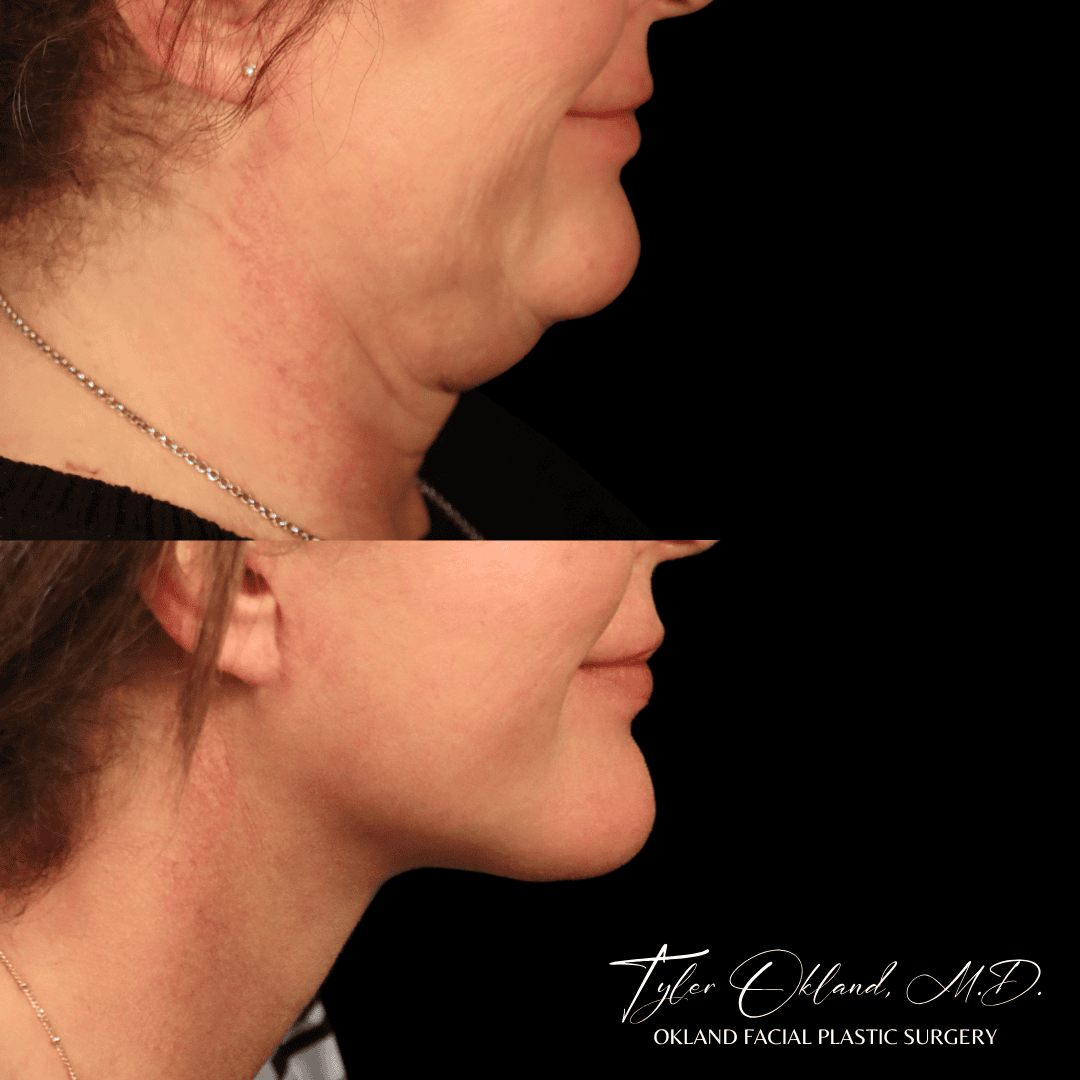
53 year-old female 7 months out from extended deep plane facelift, deep neck lift, lower blepharoplasty and fat transfer.
Learn how chin augmentation supports the jawline and neck08What Falls Short
What About Neck Liposuction?
I think neck liposuction is a poor treatment for the neck and represents a plain misunderstanding of neck anatomy.
Neck liposuction treats superficial fat, or the fat overlying the platysma somewhat unselectively.
Think about neck fat like an iceberg. What you can see of the iceberg above the surface of the water is superficial fat. But the massive volume lurking under the surface of the water is what matters; the deep neck fat.
Subcutaneous fat is precious. It sustains and cushions your neck skin over the platysma. It’s gold, which allows your skin to look bright and healthy. Removing this layer might reduce your neck volume by a few millimeters while sacrificing skin quality and making neck bands more obvious.
I remove subcutaneous fat only where it has a maximum impact on the jawline — the fat living directly under the jawline. And I remove this fat directly, sharply, rather than indirectly with a fast-moving suction cannula. Otherwise I believe in protecting and preserving the subcutaneous fat and focusing the surgical attention on the true culprits of an unrefined neck: the deep neck structures (deep neck fat, submandibular glands, digastric muscles).
Neck liposuction cannot remove deep fat beneath the platysma. It cannot reduce prominent digastric muscles or submandibular glands. It cannot repair platysmal laxity. It cannot excise loose skin. It cannot lift descended facial tissue. In fact, it can make loose muscle and skin worse.
I do not offer neck liposuction in my practice.
What About Nonsurgical Tightening or a “Nefertiti Neck Lift”?
Energy-based devices can improve skin quality and create small degrees of contraction. Neurotoxin placed into the platysma—the treatment often marketed as a “Nefertiti neck lift”—can soften platysmal pull and modestly improve selected jawline or neck-band concerns.
Neither reproduces surgical deep-fat removal, gland or digastric contouring, platysma repositioning, skin excision, or vertical deep-plane facial lifting. If the anatomy requires surgery, avoiding an incision does not make a nonsurgical treatment an equivalent operation.
09Incisions & Scars
Incisions and Scars
The scar reflects the operation required.
- Deep neck contouring — a short incision hidden beneath the chin.
- Isolated deep neck lift — the submental incision plus incisions around and behind the ears (stopping just above the tragus), allowing lateral platysma lifting, skin redraping, and skin excision.
- Facelift with deep neck lift — the same deep-neck access with a modest extension around the front of the ear and into the temporal hairline to permit vertical facial lifting.
A shorter scar is not an advantage if it prevents the surgeon from reaching the tissue that needs to be moved. Incisions generally heal beautifully regardless. The incision should match the anatomical problem, not the marketing label.


Extended deep plane facelift scars at 5 weeks (left) and at 18 months (right).
10Recovery & Safety
Recovery After Deep Neck Lift or Face and Neck Lift
The neck creates much of the swelling, bruising, tightness, and numbness in both operations, so the recovery difference is smaller than many patients expect.
Most patients reserve approximately two weeks away from minor social or professional obligations. Early swelling and tightness gradually improve, while the jawline and neck continue sharpening over the following months as swelling resolves and the tissues settle. It takes 6–8 weeks before my patients are usually “photo-ready” — meaning ready for a major event.
A combined face-and-neck operation is more comprehensive. It does not mean twice the recovery.
Deep Neck Lift Risks and Safety
Deep neck surgery is not liposuction with a better name. It works around the motor nerves, major blood vessels, salivary structures, and muscles of the floor of the mouth. It requires exact anatomy and disciplined tissue handling.
Potential risks include bleeding or hematoma, infection, adverse scarring, skin-healing problems, temporary or permanent nerve weakness in the muscles of expression in the face or neck, numbness, asymmetry, contour irregularity, salivary leak, anesthesia complications, and the possibility of revision surgery.
The exact risk profile depends on what is being treated. A consultation should define the structures causing the problem first and the operation second.
11Accurately Labeled Results
Neck Lift Results: Label the Operation Honestly
Many dramatic “neck lift” results shown online are actually facelift-and-neck-lift results. That distinction matters.
Every result on this page should be labeled by the operation that created it. If a patient underwent an extended deep plane facelift with a deep neck lift, the photograph should say exactly that. A facelift result should never be used to imply that the same neck could have been created through an isolated neck operation.

 Case 04Extended deep plane facelift + deep neck lift
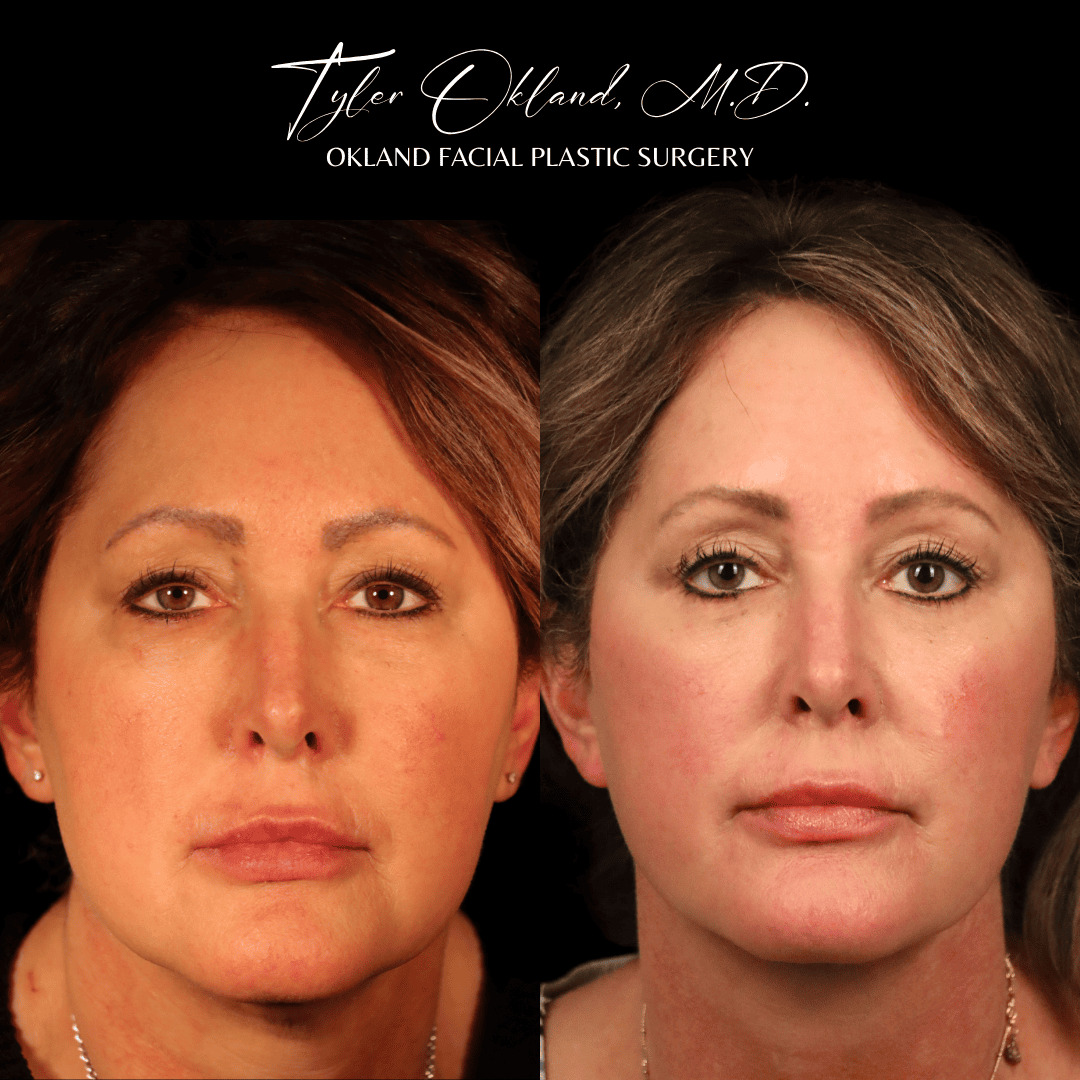 Case 03Extended deep plane facelift + deep neck lift
 Case 01Extended deep plane facelift + deep neck lift
Extended deep plane facelift + deep neck lift. The vertical facial lift and horizontal neck lift worked together to create this jawline and neck.
View Deep Plane Facelift Before and After Results12 · Why Dr. Okland
Why Choose Dr. Tyler Okland for Neck and Facial Rejuvenation?
I am a double board-certified facial plastic and reconstructive surgeon whose practice is limited to surgery of the nose, face, and neck. I trained at Stanford and completed advanced facial plastic and reconstructive surgery fellowship training at Vanderbilt.
My practice is built around high-volume rhinoplasty and facial rejuvenation surgery, including approximately 80 extended deep plane facelifts annually. Every facelift I perform includes a comprehensive deep neck lift.
My job is not to do as much surgery as possible. My job is to make people happy. I wrote this page so that you understand the extent and limitations of these surgeries. There is a lot of crosstalk on the internet these days and it is challenging to know what is real.
Meet Dr. Tyler Okland13 · Frequently Asked Questions
Frequently Asked Questions About Neck Lift and Deep Neck Lift
What is a neck lift?+
A neck lift is surgery designed to tighten and redefine the neck. The term is broad: it may describe skin redraping and platysma tightening, a deeper operation that also contours fat, muscles, or glands, or the neck component of a facelift. The important question is what structures are actually being treated.
What is a deep neck lift?+
A deep neck lift treats structures beneath the platysma in addition to the platysma and skin. Depending on the anatomy, it may address superficial and deep fat, the platysma, digastric muscles, submandibular glands, and excess skin.
What is a deep plane neck lift?+
The phrase is used inconsistently. I use it only descriptively: the important distinction is whether the operation treats the deep neck alone or also releases and vertically repositions the descended face. In my practice, deep neck surgery is part of an extended deep plane facelift when facial descent is present.
Can I get a neck lift without a facelift?+
Yes—when the problem is truly isolated to the neck. The best candidates are generally younger, have genetic neck fullness, strong skin elasticity, little or no jowling, and no meaningful facial descent.
Neck Lift vs. Facelift: Which Creates the Better Neck?+
The short answer: always the facelift. My facelift includes the deep neck lift and adds the vertical facial vector. It lifts descended cheek, lower-face, jowl, and facial skin upward while the deep neck lift defines the neck horizontally.
What is platysmaplasty?+
Platysmaplasty repairs or repositions the platysma muscle. It can improve neck bands and muscular laxity, but it is only one component of a complete neck operation when fat, glands, digastric muscle, excess skin, or facial descent also contribute.
What is a mini neck lift?+
“Mini neck lift” is not a standardized operation. It usually refers to a more limited dissection or shorter incision. Whether that is enough depends entirely on the anatomy. A smaller operation cannot correct a deeper or vertically descended problem simply because the incision is shorter.
What is the best surgery for a turkey neck?+
When the “turkey neck” is caused by loose skin and facial descent, the strongest operation is an extended deep plane facelift with a deep neck lift. The facelift restores the descended facial skin vertically; the deep neck lift tightens the platysma, removes excess skin, and sculpts the neck.
Can neck liposuction create the same result as a deep neck lift?+
No. Liposuction treats superficial fat only. It does not treat deep fat, platysma, digastric muscles, submandibular glands, excess skin, or facial descent.
What is a Nefertiti neck lift?+
It is a nonsurgical neurotoxin treatment of the platysma, not a surgical neck lift. It can modestly soften platysmal pull or neck bands in selected patients but cannot remove deep tissue, excise skin, or reproduce a surgical face-and-neck lift.
How is a deep neck lift performed?+
The operation is tailored to the anatomy. Deep structural work is performed through a submental incision. When skin redraping and lateral platysma lifting are required, incisions are added around the ears. If facial descent also needs correction, the operation becomes a face-and-neck lift with the facial tissues released and repositioned vertically.
Does a deep neck lift remove loose skin?+
Yes. An isolated deep neck lift can redrape the neck skin horizontally and excise the excess. What it cannot do is vertically redistribute facial skin that has descended into the neck. When loose submental skin is the endpoint of facial descent, a facelift produces the strongest correction.
Is a neck lift painful?+
Most patients describe tightness, pressure, swelling, and numbness more than severe pain. Discomfort varies with the extent of deep work and whether a facelift is performed at the same time.
How long is recovery?+
Most patients reserve about two weeks away from social or professional obligations. Swelling and tightness improve steadily, while final jawline and neck definition continues to emerge over several months.
How long does a neck lift last?+
The structural changes are long-lasting, but aging continues. A result is generally more coherent when every meaningful source of laxity—including facial descent—is corrected rather than leaving part of the aging pattern untreated.
How much does a neck lift cost in Denver?+
There is no meaningful single price for “a neck lift” because deep neck contouring, isolated deep neck lifting, and extended deep plane facelift with deep neck lift are fundamentally different operations. After examining the skin, platysma, deep neck structures, jaw projection, and facial descent, our office provides a specific surgical plan and exact quote.
How much longer does a facelift take than a deep neck lift?+
When I am already performing the deep neck work, adding the extended deep plane facial component usually adds 30 minutes to 1 hour in my practice. That time adds the vertical facial lifting vector that an isolated neck lift does not provide.
Deep Neck Lift & Contouring in Denver
You Came Looking for a Neck Lift. Leave With the Correct Operation.
If your neck is genetically heavy and your face has not descended, an isolated deep-neck operation may be exactly right.
If loose skin, jowls, or facial descent are present, you do not need a more aggressive horizontal neck lift. You need the vertical vector of a facelift combined with the horizontal power of a deep neck lift.
My number one goal is happy patients. Typically, the operation that creates the best neck makes patients happiest.