
Rhinoplasty in Denver, Colorado
Natural, precise rhinoplasty designed around your face, your identity and your breathing.
Written and medically reviewed by Tyler Okland, MD, double board-certified facial plastic and reconstructive surgeon. Last medically reviewed August 2026.
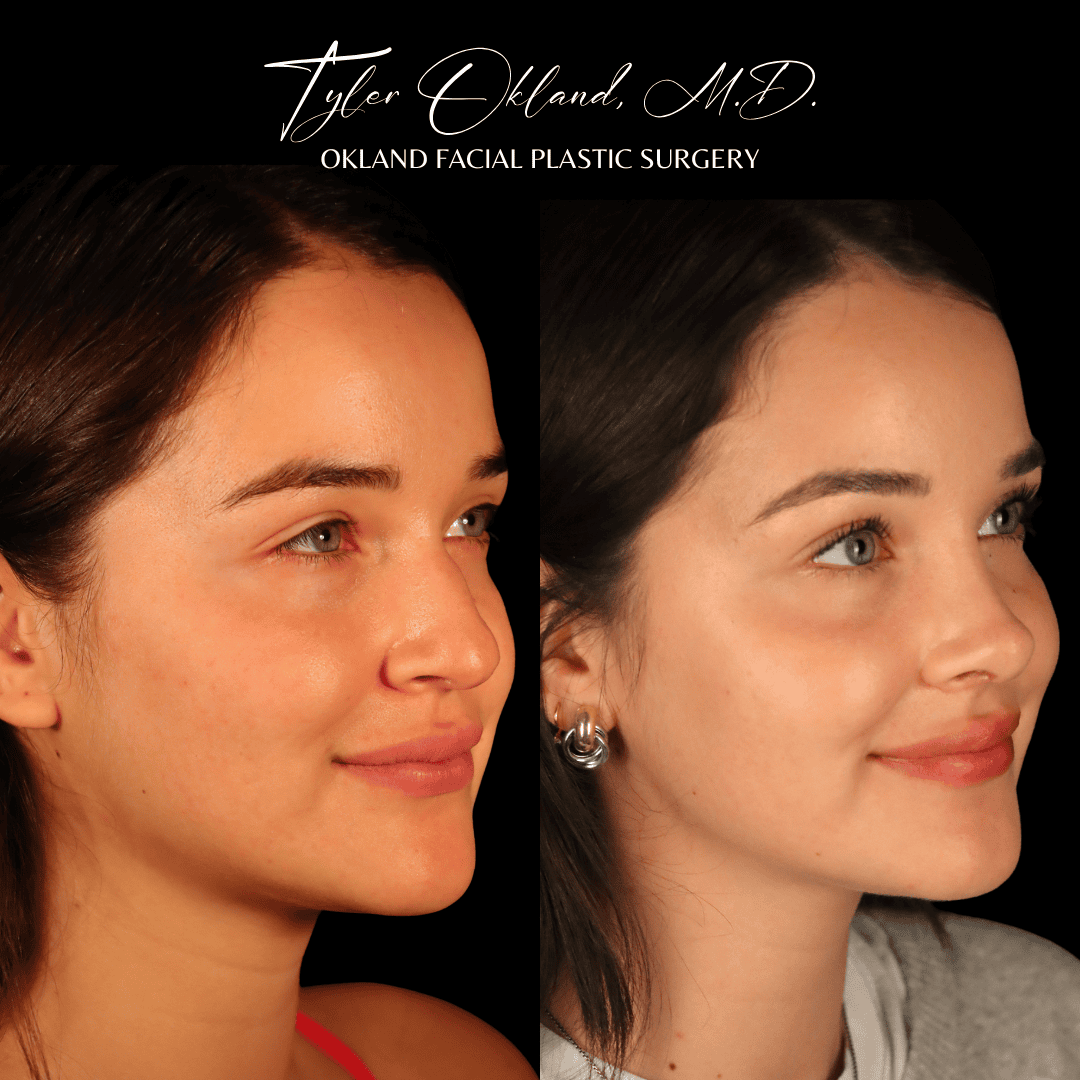
Four patients. Four anatomies. Four different operations.
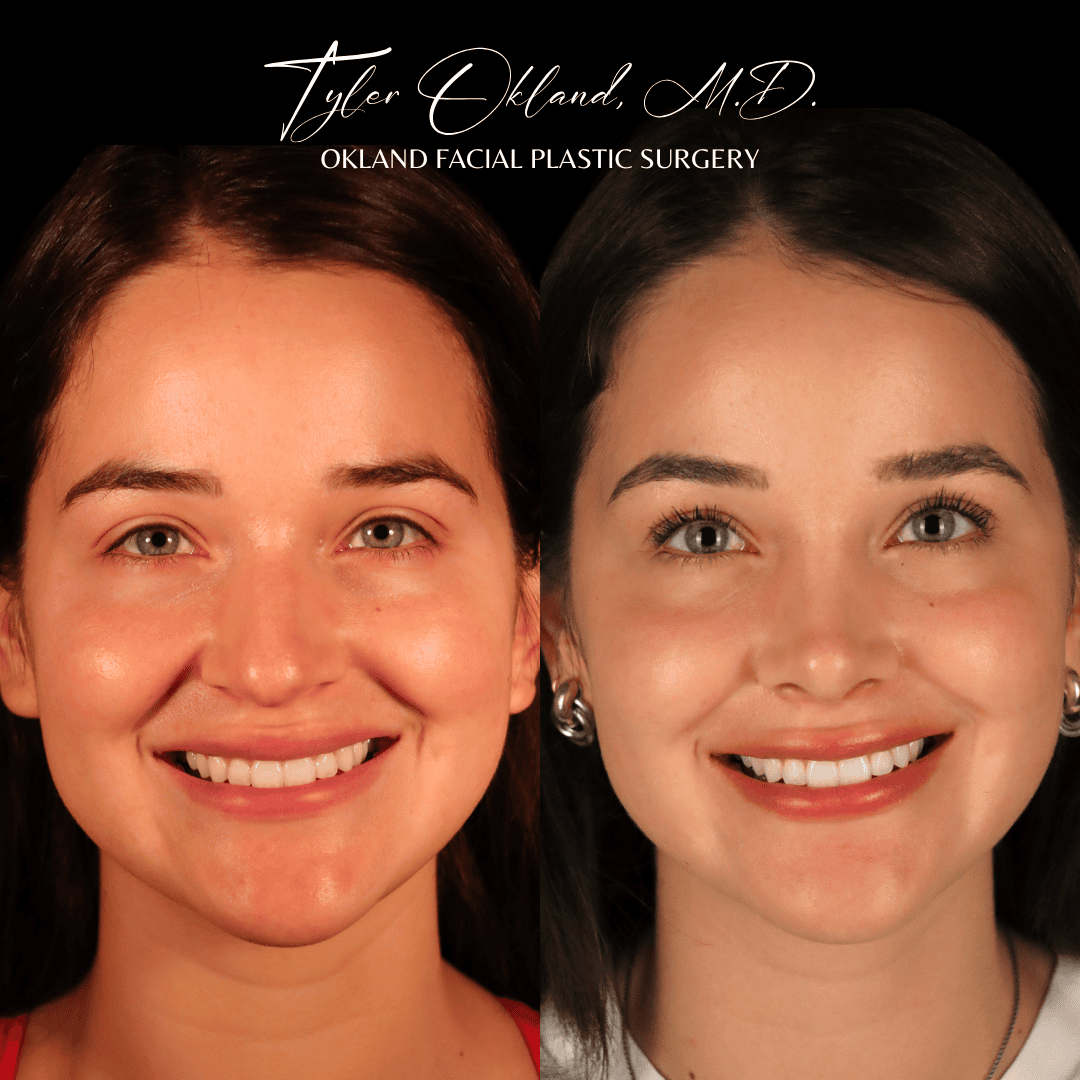
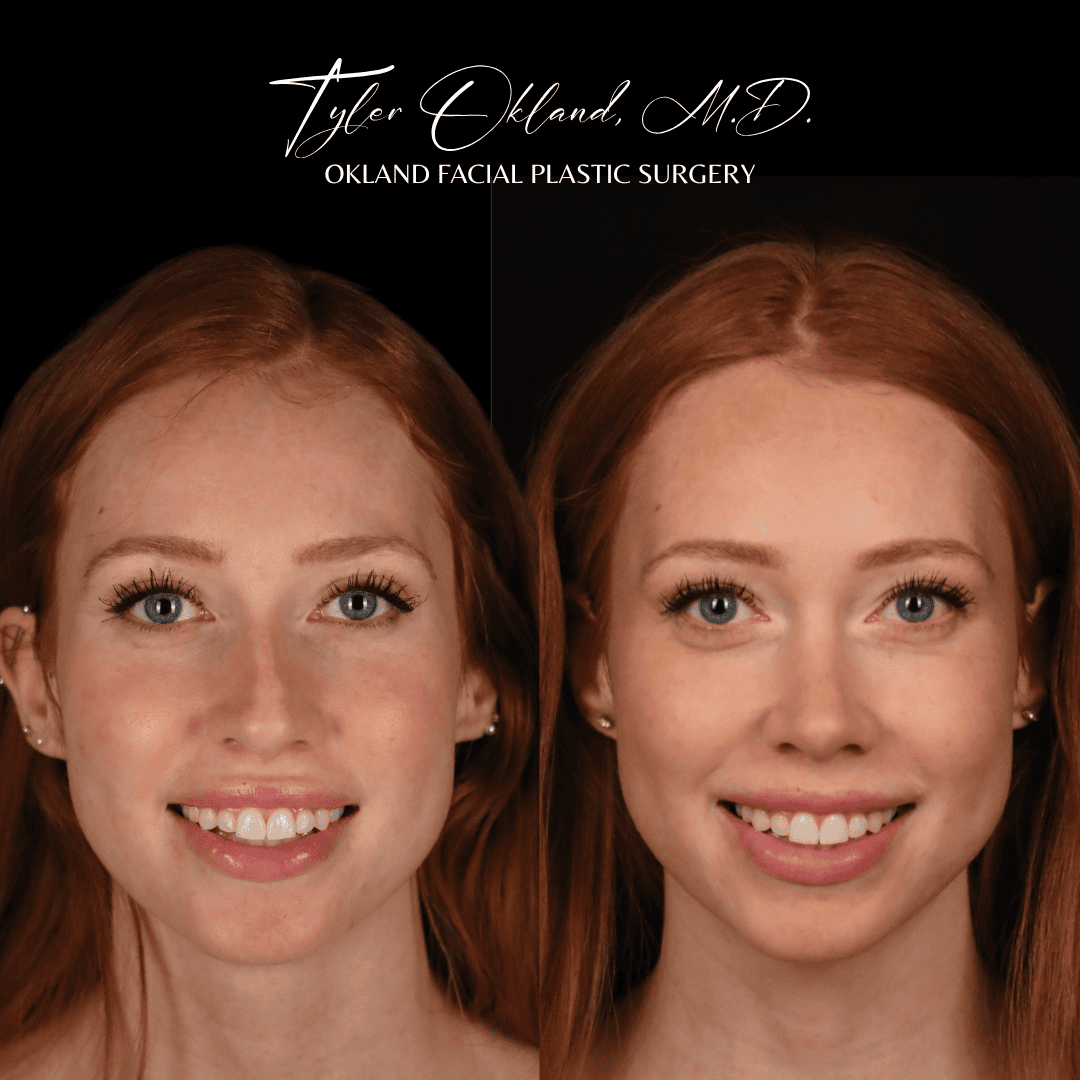
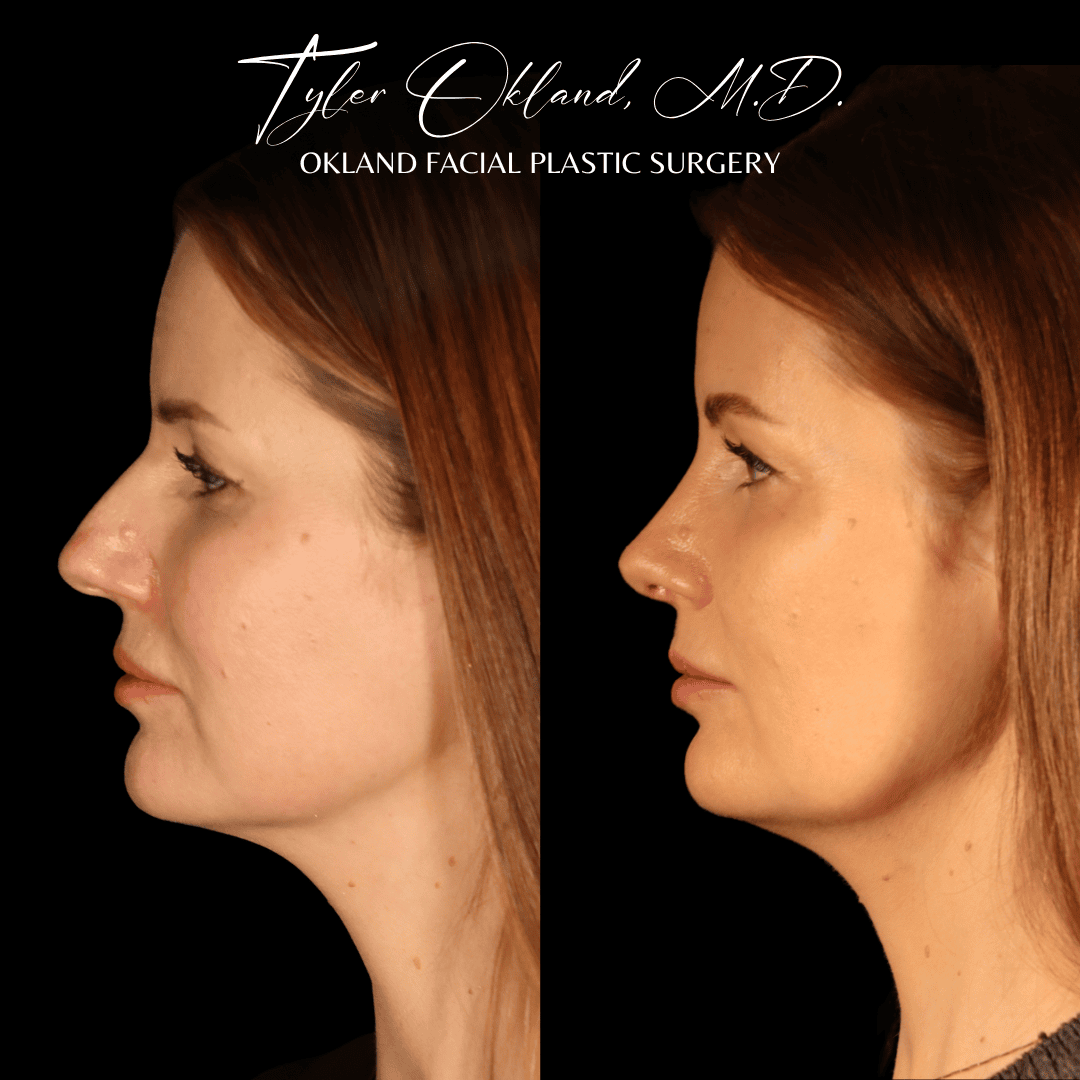
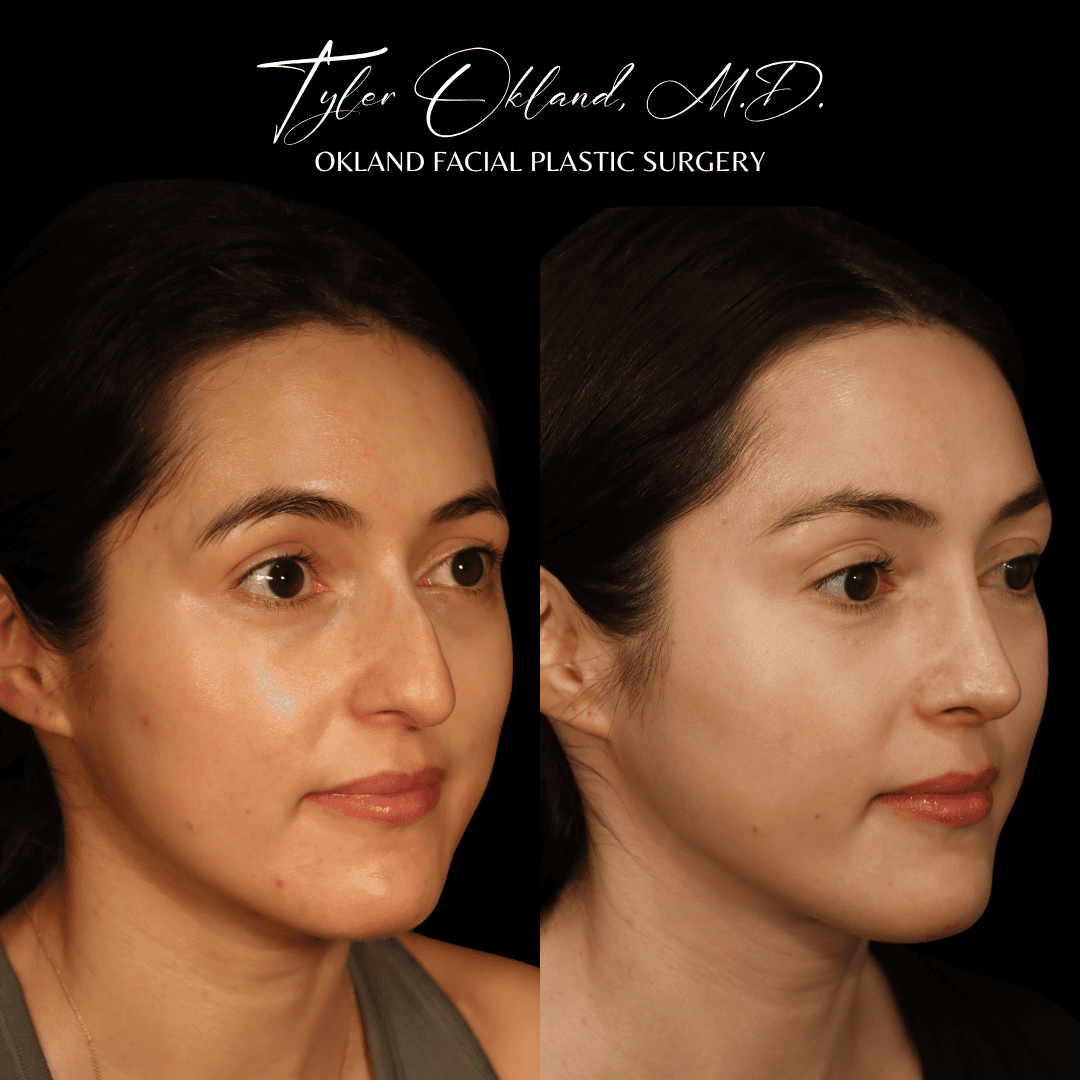
Your first rhinoplasty is a different operation.
This page is about primary rhinoplasty—the first rhinoplasty performed on a nose. If you have had previous nasal surgery, your anatomy, scar tissue and structural needs require a different approach.
Explore Revision Rhinoplasty in DenverRhinoplasty Philosophy
“I want your nose to be the supporting actress, not the leading lady.”
I believe there are certain shapes we are biologically programmed to find beautiful. Ratios, slopes and angles that—when harmonized—make music. That doesn’t mean making every nose the same. It means finding a way to optimize an individual’s anatomy to hit those high notes of beauty.
Most “nose jobs” I see look factory-built; mass-produced. In my practice, I attempt to do the opposite: build a nose that redirects attention away from itself and complements the natural beauty of your face. I want attention on your eyes, lips and smile—not your nose.
And I want your nose to breathe. I believe there is a relationship between the structures we perceive as beautiful and those that function well. At its highest level, modern rhinoplasty requires equal weighting of form and function—a firm refusal to separate the two.
Read Dr. Okland's Full Rhinoplasty Philosophy
A nose should look strong, open and supported because it should be strong, open and supported. Every rhinoplasty plan for me begins with breathing: protect it, improve it, and build beauty on that foundation.
Rhinoplasty is among the most technically demanding operations in cosmetic surgery. It requires technical precision, but also the softer powers of taste and vision—a willingness to study every millimeter in pursuit of individual harmony and refinement. And while I know perfection is not an attainable destination, I’ll spend my career chasing it for my patients.
The nose has to belong to the face around it.
My rhinoplasty assessment does not begin with the nose. It begins with the face. Before I decide what I might change, I study the anatomy the nose has to belong to: skeletal structure, chin position, radix depth, brow prominence and lip length.
I am meticulous about each view. I usually start in profile, then move to the frontal and three-quarter views. The profile gets outsized attention in rhinoplasty, but I tend to build noses for the three-quarter view.
Most human interaction happens somewhere between straight-on and perfect profile. That is where another person actually experiences your nose, and where I think true facial harmony matters most.
Brow, eyes, lips, chin, skeleton and the proportions that surround the nose.
Breathing, airflow, valve collapse, smiling, tip movement and dynamic support.
Identify what is already beautiful, protect it and optimize the rest around it.
Read the Full Assessment Approach
The frontal view is the hardest, and it is where I spend the most time. It has enormous implications for both appearance and breathing, and it is also the view you know best when you look in the mirror.
But photographs are only part of the assessment. I want to see how the nose lives. I watch how it moves during quiet breathing, listen to how it sounds, look for collapse, and watch what happens to the tip when you smile. I perform a formal functional examination of the septum, internal and external nasal valves and turbinates. I evaluate tip support, skin thickness and cartilage strength.
Then I marry all of that anatomy to identity. Are the shapes I am considering true to the patient’s ethnicity? Do they make sense for their face and the way they present themselves—their age, makeup, lip augmentation, or history of previous surgery? A beautiful nose cannot be designed independently of the person who wears it.
Finally, I always write down a few things I love about the patient’s existing nose. It may be their tip structure, the position of the nostril rims, or the relationship between the bridge and tip. Writing those things down is deliberate. It is a commitment to preserve some of the identity of that nose.
“Nearly every dimension of a nose can be changed. The harder question—and the one that matters—is which changes belong together on your face while preserving strength, identity and breathing.”
Open structural septorhinoplasty, built around form and function.
Rhinoplasty is not simply an exercise in removing a hump or making a tip smaller. The nose is a load-bearing structure: every cut, suture and graft can change both the way it looks and the way it works.
In Dr. Okland’s Denver practice, every primary rhinoplasty is performed as an open structural septorhinoplasty—exposing the framework, correcting the septum and airway, and rebuilding the nose with cartilage so the final shape is deliberate, supported and designed to age well.
Visibility measured in millimeters.
“Open” describes how Dr. Okland accesses the nasal framework. A small inverted-V incision across the columella connects to incisions hidden inside the nose, allowing the skin and soft-tissue envelope to be lifted so the bridge, tip cartilages and septum can be seen directly.
Why the open approach matters
Rhinoplasty is measured in millimeters. Direct visualization makes subtle asymmetries easier to identify and allows Dr. Okland to evaluate how the bridge meets the tip, how the two tip cartilages differ, whether the septum is pulling the nose off axis, and whether the internal or external nasal valves need additional support.
The external incision typically heals as a fine, inconspicuous line.

The septum is both airway and architecture.
The nasal septum divides the two nasal passages, but it is also the central load-bearing support of the nose. It helps hold up the bridge, anchors the tip and influences whether the nose sits straight on the face.
A bent septum can narrow the airway, pull the nose or tip off center and distort the dorsal aesthetic lines visible from the frontal and three-quarter views.
“Where goes the septum, goes the nose.”
Read How Dr. Okland Approaches Septoplasty
Every rhinoplasty Dr. Okland performs includes a septoplasty, making the operation a septorhinoplasty. He exposes the septum, identifies bent or deviated segments and removes, straightens or repositions the portions that are obstructive or distorting the nose.
Septoplasty does not mean removing the entire septum. The strong dorsal and caudal borders—the L-strut—are preserved or reconstructed because they support the bridge and tip.
The internal and external nasal valves and inferior turbinates are also assessed in every case. When they contribute to obstruction, the valves can be strengthened and the turbinates conservatively reduced or lateralized while preserving their function.
Rebuild first. Refine second.
Cartilage removed during septoplasty often becomes the best building material in the operation. Once the load-bearing L-strut is preserved, straight usable cartilage can be shaped into small grafts and secured back into the nose to create support, definition and precise control.
Septal Extension Graft
A central foundation used to control tip projection, rotation and axis and to resist recurrent drooping.
Spreader Grafts
Slender cartilage strips that can straighten dorsal lines, improve symmetry and support the internal nasal valves.
Radix Graft
A low-profile graft at the root of the nose that can soften the brow-to-tip line and change how nasal length is perceived.

Read More About Cartilage Grafting
The graft pattern is different for every nose. Dr. Okland uses a septal extension graft in approximately 99% of his rhinoplasties. By changing its length, angle and orientation, he can control tip projection, rotation and axis.
Spreader grafts can improve both the appearance of the bridge and the function of the airway because those two objectives are anatomically inseparable. When the radix is low or deep, a small graft can create a smoother, more continuous line from brow to tip.
When the septum cannot provide enough straight or strong cartilage, the patient’s own rib or donor rib cartilage may be used instead.
The tool matters less than the judgment behind it.
Piezo describes an ultrasonic instrument used to cut or contour nasal bone. It can be useful for precise bony work, but it cannot analyze a face, choose the right profile, straighten a septum, set tip projection or rebuild a nasal valve.
Choosing a rhinoplasty surgeon because they advertise piezo is a little like choosing a barber because they advertise sharper shears. The tool may be excellent; the result still depends on the person holding it.
Refinement without erasing identity.
Ethnic rhinoplasty is not one operation, and there is no single African, Asian, Middle Eastern, Latino or mixed-heritage nose. The term describes something more important: changing the features a patient wants changed without erasing the anatomy, identity or family resemblance they want to keep.
Dr. Okland’s objective is never to “Westernize” a face. It is to create a nose that appears more balanced, refined and structurally sound while remaining unmistakably true to the person wearing it.
The operation should be comprehensive, but the result should still feel personal: your identity preserved, your airway protected, and your nose optimized for the face you were born with.
Definition has to be built from underneath.
Thick skin cannot simply be made to behave like thin skin. It can conceal even beautifully shaped cartilage beneath it, which means definition must be created with a framework strong enough to shape and support the soft-tissue envelope.
Read More About Thick-Skin Rhinoplasty
In selected patients, Dr. Okland may carefully thin targeted fibrofatty tissue over and between the tip cartilages while preserving a healthy skin flap and its blood supply. The goal is not indiscriminate thinning. It is to take definition to the limit of what that patient’s skin can safely display.
When the nostrils or alar base are excessively wide or flare with smiling, the nasal base can also be narrowed and reshaped with carefully placed incisions hidden in the natural creases around the nostrils. The amount and pattern of reduction are customized.
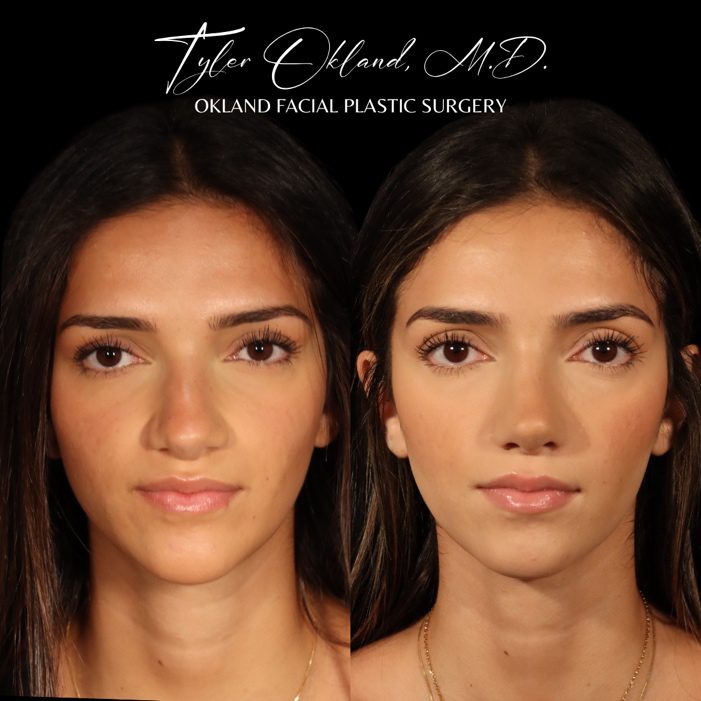 Frontal View
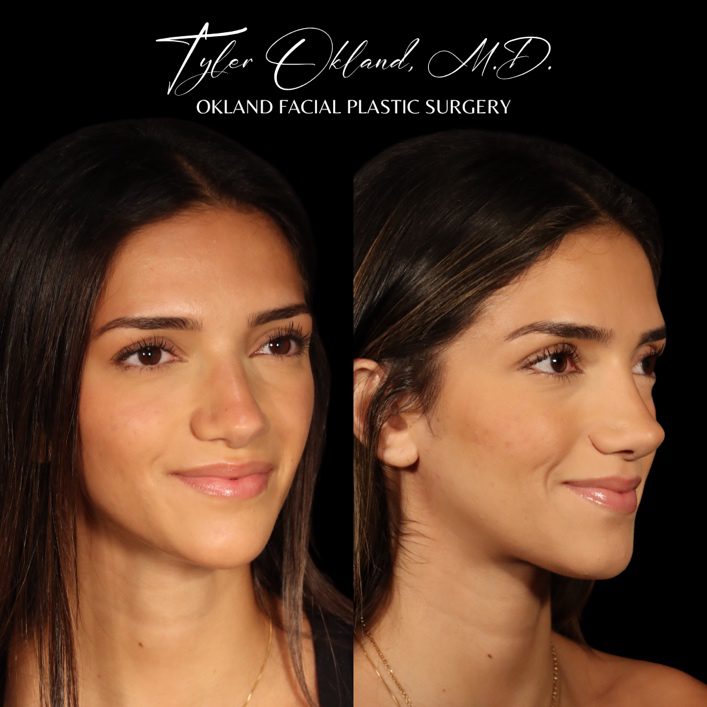 Oblique View
Sometimes harmony comes from adding, not subtracting.
Some patients need addition rather than reduction. When the bridge or radix is low, dorsal augmentation can create height, improve the brow-to-tip line, strengthen frontal definition and bring the nose into better balance with the eyes, lips and chin.
Read More About Dorsal Augmentation
This can be especially useful in patients who need greater bridge height or stronger structural definition, although the decision is based on individual anatomy and the desired result—not ethnicity alone.
When substantial strength or volume is required, Dr. Okland may harvest a segment of the patient’s own rib cartilage and sculpt it into a dorsal graft. The graft can be wrapped in rectus fascia to soften its edges and help it blend beneath the nasal skin.

Every plan starts with the individual nose.
Different anatomy requires a different operation.
Rhinoplasty is not a standardized set of maneuvers. Each operation begins with the patient’s existing anatomy, the features they hope to change, the features they want preserved and the structural support required for long-term form and function.
Case-specific surgical details can be added once approved by Dr. Okland.
Primary Rhinoplasty
Case-specific concern pending Dr. Okland’s approved clinical notes.
Individual surgical approach pending client-approved case details.
Final result language will be matched to the approved clinical description.
Primary Rhinoplasty
Case-specific concern pending Dr. Okland’s approved clinical notes.
Individual surgical approach pending client-approved case details.
Final result language will be matched to the approved clinical description.
Primary Rhinoplasty
Case-specific concern pending Dr. Okland’s approved clinical notes.
Individual surgical approach pending client-approved case details.
Final result language will be matched to the approved clinical description.
Primary Rhinoplasty
Case-specific concern pending Dr. Okland’s approved clinical notes.
Individual surgical approach pending client-approved case details.
Final result language will be matched to the approved clinical description.
Healing happens in stages.
The first week is only the beginning. Bruising and obvious swelling improve early, while refinement continues gradually over the months that follow.
Your recovery is individual. Dr. Okland and his team follow healing closely and provide patient-specific postoperative instructions and follow-up.
Protect & recover.
Expect visible swelling and possible bruising. A nasal splint or cast may be used during the initial healing period, with early postoperative follow-up to monitor recovery and remove sutures, packing or the cast when appropriate.
Back into the world.
Initial swelling and bruising continue to settle. Follow-up appointments allow the team to assess healing and guide the return to normal activities based on the individual operation and recovery.
Refinement takes time.
The nose continues to heal as residual swelling gradually resolves. Subtle definition and the final result become more apparent over time rather than all at once.
Plan to stay long enough for Dr. Okland to see you before you fly home.
For patients traveling by air, the practice asks that you arrive the morning before surgery and remain in Denver for a minimum of six days after surgery. Every surgical patient should also have a friend, family member or caretaker with them the night of surgery.
Read the Out-of-State Patient GuideRhinoplasty recovery is not a single finish line. Early healing is measured in days and weeks; the more subtle evolution of the nose is measured in months.
A beautiful result still has to be a safe operation.
Rhinoplasty is surgery. Even with careful planning and meticulous technique, no surgeon can eliminate every risk or guarantee a specific cosmetic or functional outcome.
The purpose of a thoughtful consultation is not to minimize those realities. It is to understand your anatomy, health, goals and risk profile—and make sure you understand the operation before deciding to proceed.
Risk is part of informed consent—not fine print.
Potential rhinoplasty complications include anesthesia-related risks, infection, changes in sensation, scarring or poor wound healing, persistent or new breathing difficulty, septal perforation, prolonged swelling or discoloration, an unsatisfactory appearance and the possibility of revision surgery.
Some concerns are temporary and improve as healing progresses; others may require additional treatment. Your individual risks and alternatives should be discussed directly with Dr. Okland before surgery.
Appearance and nasal breathing are considered together because changes to support can affect both.
Swelling, scar behavior, asymmetry and tissue response differ from patient to patient.
No rhinoplasty result can be guaranteed, and some patients may ultimately need additional treatment or surgery.
Questions worth discussing before surgery.
Your consultation should leave room for questions.
Ask what technique is recommended for your anatomy, how breathing will be evaluated, what recovery is likely to look like, what complications are possible, how complications are managed and what options exist if the cosmetic outcome does not meet expectations.
This page is educational and does not replace individualized medical advice, a formal surgical consultation or the informed-consent process.
The questions patients ask before rhinoplasty.
Rhinoplasty is highly individualized. These answers are meant to provide useful orientation; your consultation is where Dr. Okland can apply them to your anatomy, breathing and goals.
01How long does rhinoplasty recovery take?
Recovery varies by patient and by the operation performed. Initial bruising and more obvious swelling generally improve during the first few weeks, while residual swelling and refinement continue for months. Dr. Okland follows patients after surgery and provides individualized guidance for activity and healing.
02Will I have a visible scar?
Dr. Okland performs primary rhinoplasty using an open approach. This uses a small incision across the columella between the nostrils in addition to incisions inside the nose. The external incision is designed to heal as a fine, inconspicuous line, although scar healing varies between patients.
03Can rhinoplasty improve my breathing?
It can when breathing difficulty is related to structural nasal problems. Dr. Okland evaluates the septum, nasal valves and other contributors to airflow and considers function alongside appearance when planning rhinoplasty.
04What is the difference between primary and revision rhinoplasty?
Primary rhinoplasty is the first rhinoplasty performed on a nose. Any later nasal operation is considered revision rhinoplasty. Previous surgery can change cartilage availability, scar tissue and structural support, so revision cases require a different evaluation and surgical plan.
05How do I know what nose will fit my face?
Dr. Okland approaches rhinoplasty face-first. He evaluates the nose in relationship to surrounding facial anatomy rather than selecting a standardized nose shape. The goal is to refine the features you want changed while preserving identity and facial harmony.
06Does every rhinoplasty include septoplasty?
In the surgical approach described by Dr. Okland for this page, primary rhinoplasty includes evaluation and treatment of the septum as part of septorhinoplasty. The exact maneuvers depend on the individual patient's anatomy and functional needs.
07When will I see my final rhinoplasty result?
You will see a meaningful change early, but a rhinoplasty result continues to evolve as swelling resolves. Subtle definition may take several months to become apparent, and the pace of healing varies by patient and by areas of the nose.
08Can I travel to Denver for rhinoplasty?
Yes. The practice treats many patients who travel for surgery. Current guidance asks patients flying to Denver to arrive the morning before surgery, remain in Denver for at least six days afterward and have a friend, family member or caretaker with them the night of surgery.
Read the Out-of-State Patient Guide09How do I know if I am a good candidate?
Candidacy depends on more than a cosmetic concern. Overall health, facial growth, nasal anatomy, breathing, goals and expectations all matter. A consultation allows Dr. Okland to examine your nose and discuss whether surgery is appropriate for you.
10What happens during a rhinoplasty consultation?
The consultation is used to discuss your concerns and goals, evaluate the structure and function of your nose and determine what changes are realistic. It is also the time to discuss the proposed surgical approach, recovery, potential risks and your questions before making a decision.
Start with the face.
Then design the nose.
A rhinoplasty consultation with Dr. Okland is a conversation about what you notice, what you want to preserve, how your nose functions and what changes actually belong on your face.
Your nasal structure, breathing and goals are evaluated before a surgical plan is recommended. The consultation is also your opportunity to ask questions about technique, recovery, risks and what a realistic result may look like for you.
3900 E Mexico Ave
Suite 501
Denver, CO 80210
Out-of-state patients can review travel timing, caretaker guidance and postoperative stay recommendations before scheduling.
Out-of-State Patient GuideContact the practice directly if you need help determining the appropriate appointment or have questions before scheduling.
Contact the PracticeIndividual results vary. Information on this page is educational and does not replace an individualized consultation, medical advice or the informed-consent process.